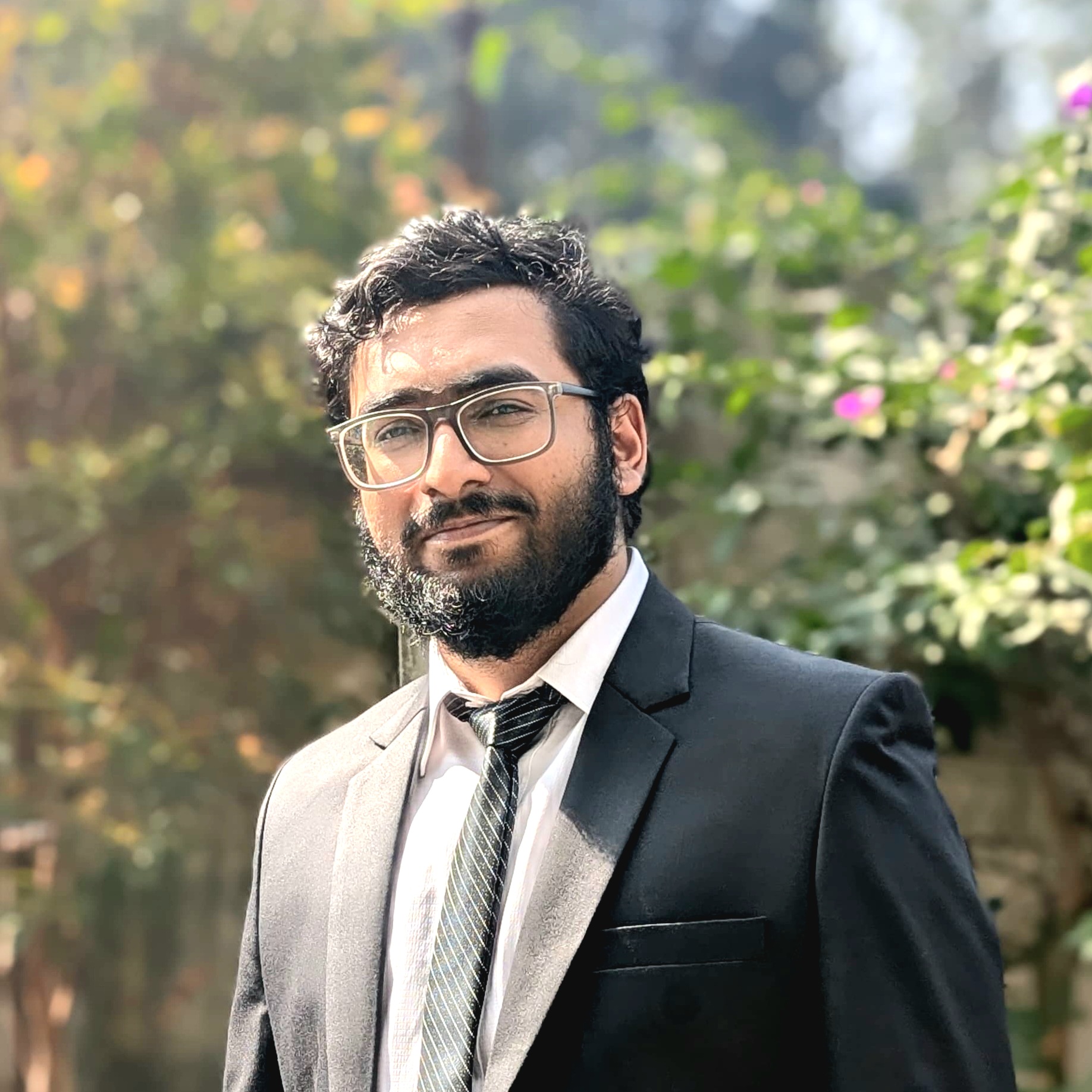
Shah Nawaz Haider

Undergraduate Researcher · Data Scientist, Synnax AI

B.Sc. in Computer Science & Engineering
University of Science and Technology Chittagong (USTC)

I am looking for a PhD position.

My research interest is in world models and language world models, how large models internalize the dynamics they're trained to predict, and how those representations can be learned and used far more efficiently. My undergraduate thesis, QuantFlow, introduced a federated Mamba-based foundation model for time-series forecasting, and my broader work spans multiple peer-reviewed papers across time-series forecasting, natural language processing, federated learning, and explainable AI.

Research Interests World Models · Large Language Models · Agentic Reasoning · Efficient AI

Portrait of Shah Nawaz Haider

Research Vision

“How much of the world must a model internalize before it can reason about what it predicts?”

That question organizes my research. Over the past three years I have built predictive models of real systems, from electrical grids and farmland to river flows and corporate filings, usually under tight constraints of data, privacy, and compute. Those constraints forced me to ask not just whether a model predicted well, but what it must have learned to do so. That is the question I want to pursue in a PhD.

Selected Publications

Full list and citation metrics on Google Scholar. Author names are shown as they appear in print; my name is bold.

Preprint & Thesis

  1. QuantFlow: A Federated Mamba-Based Post-Transformer Foundation Model for Time-Series Forecasting

    S. N. Haider, S. Austin, A. Barua, S. M. Shawon, and H. Ullah

    arXiv preprint arXiv:2607.02632, 2026 · Undergraduate thesis, USTC · Supervisor: Dr. Hadaate Ullah

    PreprintFirst authorThesis

    A privacy-preserving univariate forecasting foundation model built on bidirectional Mamba state-space decoders, with TSMixup augmentation and a pinball-loss quantile head. Zero-shot R² above 0.8 on four of five unseen domains at the 96-step horizon; the federated variant stays within 0.05 R² of centralized training across ten datasets, without any client sharing raw data.

Peer-Reviewed Publications

  1. Lightweight Federated and Explainable AI Enhanced Crop Yield Forecasting in Heterogeneous Agricultural Systems

    S. N. Haider, A. Barua, S. Austin, and S. M. Shawon

    Proc. 28th International Conference on Computer and Information Technology (ICCIT), IEEE, 2025

    First authorConference

    Combined federated learning with explainable AI so that data from many farms could be pooled without any farm surrendering its raw data, showing that accurate, inspectable prediction is possible even when data is fragmented and private.

  2. Hybrid CNN-LSTM Model for Urban Energy Load Forecasting with IGA-XAI for Smart Grids

    S. M. Shawon, S. N. Haider, A. Barua, S. Austin, I. A. Adan, M. S. Hossain, and H. T. Zubair

    Results in Engineering (Elsevier), art. no. 107245, 2025

    JournalQ1 · IF 7.9

    Hybrid convolutional-recurrent networks for urban electricity load forecasting in Chattogram, combined with explainable AI so the predictions could be inspected rather than merely consumed. I helped build the hybrid deep learning models and the explainability pipeline.

  3. Urban Energy Load Dataset of Chattogram: Peak and Off-Peak Variability Insights

    A. Barua, S. N. Haider, S. Austin, and S. M. Shawon

    Data in Brief (Elsevier), vol. 63, art. no. 112245, 2025

    JournalDataset paper

  4. AgriLightFed: Lightweight Federated Learning with Explainable AI for Efficient and Privacy-Preserving Crop Yield Prediction

    S. M. Shawon, P. Dutta, S. N. Haider, A. Barua, S. Austin, and I. A. Adan

    Proc. 28th International Conference on Computer and Information Technology (ICCIT), IEEE, 2025

    Conference

  5. Precision Classification of Potato Diseases Using Transformer-Enhanced CNNs

    S. Austin, A. Barua, S. N. Haider, F. L. Niha, M. Faisal, and S. M. Shawon

    Proc. International Conference on Quantum Photonics, Artificial Intelligence, and Networking (QPAIN), IEEE, 2025

    Conference

  6. Bi-LSTM-RF Based Hybrid Deep Learning Approach to Identify Level of Depression from Bengali Facebook Status

    S. Austin, S. N. Haider, R. Shil, N. S. Lija, and K. R. Noor

    Proc. 27th International Conference on Computer and Information Technology (ICCIT), IEEE, 2024

    ConferenceBengali NLP

  7. HybridNet: ResNet50-GRU Integration for Enhanced Rice Leaf Disease Classification

    S. M. Shawon, S. N. Haider, S. Austin, and A. Barua

    Proc. MIET, Springer Lecture Notes in Networks and Systems, 2024

    Conference

  8. DeepFlowNet: Deep Learning Based Daily Water Flow Forecasting

    S. M. Shawon, S. N. Haider, A. Chakma, M. W. Alam, M. T. Islam, and M. F. Rana

    Proc. IEEE International Conference on Power, Electrical, Electronics and Industrial Applications (PEEIACON), IEEE, 2024

    Conference

Featured Research Projects

QuantFlow: A Federated Mamba-Based Post-Transformer Foundation Model for Time-Series Forecasting

Undergraduate thesis · USTC · Supervisor: Dr. Hadaate Ullah

Problem. Forecasting models are typically trained per system, learn one narrow domain from scratch, and transfer nothing. Meanwhile, real-world training data is often fragmented and private.

Approach. A privacy-preserving univariate forecasting framework built on bidirectional Mamba state-space decoders, trading the transformer's quadratic cost for linear scaling in sequence length and memory. TSMixup augmentation (Dirichlet-weighted interpolation) expands coverage of the temporal manifold, and a probabilistic projection head trained with pinball loss emits five-quantile, uncertainty-aware forecasts.

Outcome. Competitive with strong transformer baselines on held-out series; zero-shot R² above 0.8 on four of five unseen domains at the 96-step horizon; federated training within 0.05 R² of centralized training across ten datasets, without any client sharing raw data. Published as an arXiv preprint.

PyTorch · Mamba / State-Space Models · Federated Learning · Probabilistic Forecasting

Bengali BPE Tokenizer

Open-source project · 87+ stars on GitHub

Problem. Tokenizers built for English inflate Bengali text severalfold, a tax on every training run and every inference call, paid most heavily by the communities least able to afford it.

Approach. Designed and trained a Byte Pair Encoding tokenizer from scratch for Bengali and other non-Latin scripts, processing 3.4 billion characters from the CC-100 Bengali corpus into a fixed vocabulary of 8,000 subword units, with custom handling for multi-byte UTF-8 characters and complex conjuncts.

Outcome. Encodes Bengali text with 7.33× fewer tokens than GPT-2's tokenizer, significantly reducing token inflation and inference costs for under-resourced languages. The project taught me that what a model can afford to learn is decided partly at the representation layer.

Python · Byte Pair Encoding · CC-100 Corpus · Low-Resource NLP

LunaWave: 3D Lunar Seismic Data Visualization

Regional Champion · NASA International Space Apps Challenge 2023

Problem. Apollo-era lunar seismic data is scientifically valuable but difficult to explore in its raw archival form.

Approach. Built an interactive web application to visualize lunar seismic data sourced directly from NASA's Planetary Data System, integrating spatial overlays that map mineral composition and Bouguer gravity disturbances against seismic event locations.

Outcome. Regional Champion, NASA International Space Apps Challenge 2023 (Dhaka).

JavaScript · Data Visualization · NASA Planetary Data System

Professional Experience

Aug 2024 – May 2026

Data Scientist · Synnax AI

Dubai, United Arab Emirates (Remote)

  • Engineered and deployed end-to-end ML pipelines for credit risk and default prediction, processing SEC filings and market data for 16,000+ public companies.
  • Built LLM-powered AI agents to extract critical risk signals from 10-K, 10-Q, and 8-K filings, automating identification of high-risk and defaulted entities.
  • Transformed large-scale unstructured regulatory data into production-ready features for downstream modeling and analytics.
  • Worked with vector databases, PostgreSQL, Redis, and MongoDB in a production MLOps environment.

May 2024 – Jul 2024

Data Scientist (Part-time) · Omdena

Milan, Italy (Remote)

  • Collected, cleaned, and preprocessed urban agriculture datasets (environmental, spatial, and crop-related variables) for machine learning workflows.
  • Developed and evaluated machine learning models for crop optimization, resource allocation, and data-driven agricultural decision-making.
  • Contributed to research documentation, model evaluation, and presentation of insights to project stakeholders.

Teaching & Leadership

Explaining an idea is the fastest way to find its weak points; I want any group I work in to run on that principle.

Jul 2024 – Jun 2025

President · USTC Programming Club

  • Led the university programming club, organizing technical workshops, coding competitions, and community events.
  • Coordinated club activities to promote programming, problem-solving, and collaborative learning among CS students.
  • Mentored members in competitive programming and software development, fostering an active technical community.

Sep 2023 – Nov 2023

Peer Tutor · USTC

  • Conducted tutoring sessions for undergraduate students on foundational programming and computational problem-solving.
  • Taught core procedural programming concepts using C, including control structures, functions, and algorithmic thinking.
  • Mentored students through hands-on coding exercises and individualized academic support, strengthening logical reasoning and debugging skills.

Jul 2023 – Jun 2025

Member · USTC Robotics Society

  • Architected an autonomous path-following robotic system by optimizing sensor fusion algorithms.
  • Collaborated with multidisciplinary teams to debug embedded systems and troubleshoot complex circuitry.

Awards & Achievements

  • 2026
    Champion, Project Competition · Research Colloquium, USTC
  • 2025
    Champion, Poster Competition · Winter School Colloquium, USTC
  • 2023
    Regional Champion · NASA International Space Apps Challenge, Dhaka for LunaWave, an interactive 3D visualizer of Apollo-era lunar seismic data

Certifications

Technical Skills

Programming Languages
Python, Java, JavaScript, C/C++, MATLAB, SQL
ML / DL Frameworks
PyTorch, TensorFlow, Keras, Scikit-learn, XGBoost, Hugging Face Transformers
LLM & Agentic AI
LangChain, Retrieval-Augmented Generation (RAG), Vector Databases, LoRA/QLoRA
Federated & Explainable AI
Flower, SHAP, LIME, Integrated Gradients
Data & Databases
Pandas, NumPy, Matplotlib, Plotly, PostgreSQL, MongoDB, Redis
Cloud & Infrastructure
AWS (EC2, S3, RDS), Docker, Kubernetes

Contact

Please feel free to get in touch. I read every email :)

nawazwithai@gmail.com